AUTOMATIC CANNIBALIZATION TESTS Module

Daily, Controlled SEO–SEA Experiments. Zero Manual Work.

A safe, automated testing engine that pauses one overlapping query per day, tracks real organic impact, measures SEA savings, and classifies every keyword into a 100-day success or failure lifecycle. Fully transparent, fully incremental, and completely hands-off.
*Requires Search Analytics Module.
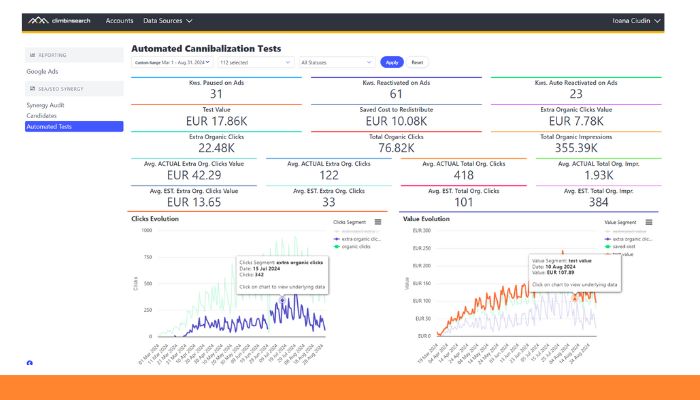
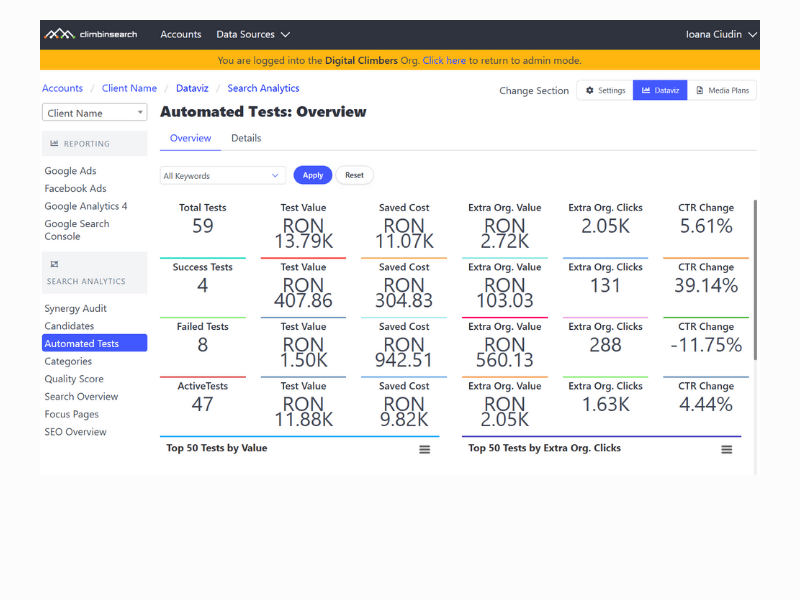
Dashboard showing Automated Cannibalization Tests with metrics for paused ads, reactivated ads, cost savings in EUR, organic clicks, impressions, and two trend line graphs for clicks and value evolution over time.
How it works

Automated Cannibalization Testing in 4 Simple Steps

Understand exactly how the system identifies overlap, runs daily tests, and measures real SEO–SEA synergy, with no manual work.

1. Connect Your Data

Link Google Search Console and Google Ads. No imports, no setup complexity. The system automatically identifies the Cannibalization Zone and applies a multi-criteria model to surface eligible test candidates.
You can exclude any keyword you don’t want to test.

2. Get Monthly Test Candidates

At the start of each month, ClimbinSearch analyzes SEO + SEA data and generates up to 31 qualified test candidates.
Only queries with strong SEO, active SEA, and safe impression parity make the list.

Enable Tests. The System Does the Rest

Just click Enable Tests and the automation starts. Each day, one keyword enters testing while ClimbinSearch tracks expected indicators. Keywords are added as Negative Exact in Google Ads so you can see the list directly in your account.
If a keyword doesn’t meet expected values during the test, it is automatically removed from the list and reactivated safely.

4. Measure Real Organic Lift

Each keyword follows the same lifecycle: Learning → Test → Reactivation → Success/Fail.
You get clear, comparable signals showing where SEO can take the lead and where SEA should remain active.
When a keyword is excluded, its SEA budget naturally shifts toward other search terms in your campaigns. No manual reallocation needed.
Take Control of Your SEA–SEO Cannibalization, Automatically
Stop guessing where Paid and Organic overlap. Let ClimbinSearch test it for you, every day, keyword by keyword.  Zero manual work.
Book a Demo
Integrations

Works with the Essentials You Already Use

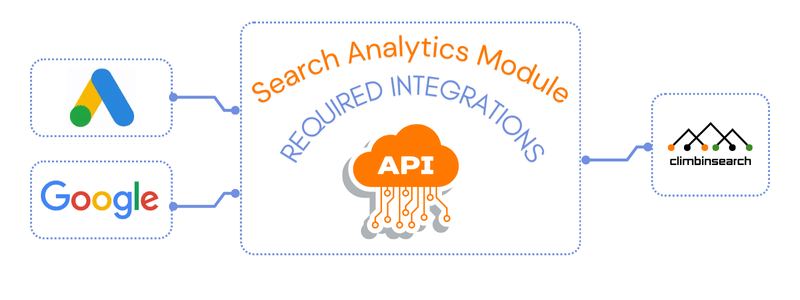
Automatic Cannibalization Tests rely on two native Google integrations for Search Analytics:
🔗Google Search Console
🔗Google Ads
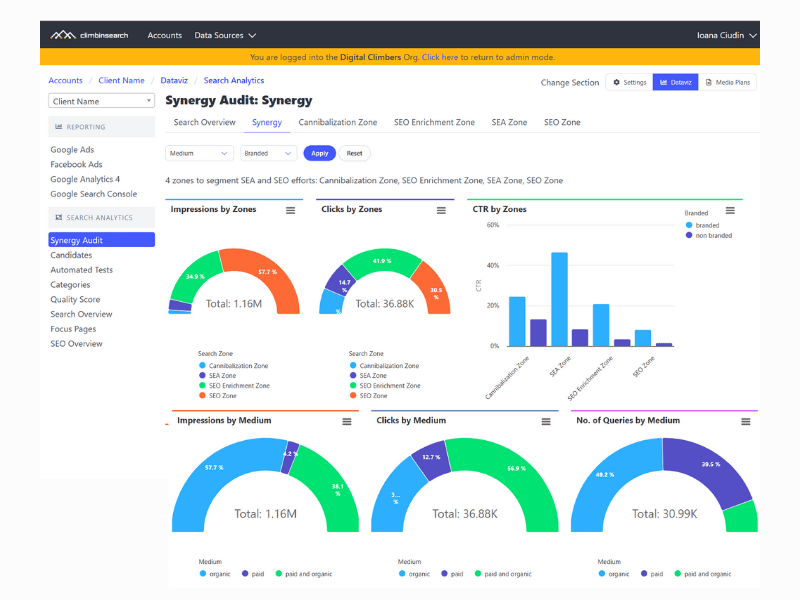
Search Analytics must be active, the monthly candidate list and eligibility rules come directly from its unified SEO + SEA model.
media plan summary in Climbinsearch

Automate Your SEA–SEO Cannibalization Tests with Zero Operational Effort.

Let the system test one keyword a day, measure real organic uplift, track cost savings, and show how both channels work together.
Safely and transparently.
Book a Demo

Frequently Asked Questions

Automatic Cannibalization Tests are built to remove guesswork from SEO and SEA overlap.
Below are answers to the questions teams ask when they want to validate incrementality and make confident budget decisions.

Still have questions?

If you want to review overlap risk, test design, or how to interpret cannibalization signals, book a short call and we’ll guide you through the best setup.
Contact Us
We already look at SEO and SEA. What problem does this module solve?

Most teams can see both channels.
They cannot prove interaction.

This module solves the blind spot between correlation and causation by guiding teams toward measurable signals and structured tests.

How is this different from Search Analytics?

Search Analytics detects overlap patterns.
Cannibalization Tests validate what is incremental.

It is the execution layer that helps confirm whether paid is adding value or replacing organic clicks.

Who uses this module day to day?

Paid search and SEO specialists use it to choose what to test and what to adjust.

Performance leads use it to protect efficiency and explain decisions.
Management uses it to gain confidence that spend is incremental.

When does it make the biggest difference?

When search budgets are meaningful and overlap is likely: strong organic rankings, always on paid coverage, or multiple query groups where paid and organic compete.

What do we test and what do we learn?

You test how performance changes when you reduce or shift paid pressure on specific query groups.

The outcome is clarity on where paid is incremental, where it is cannibalizing, and how to rebalance budgets, bidding, and SEO priorities.