
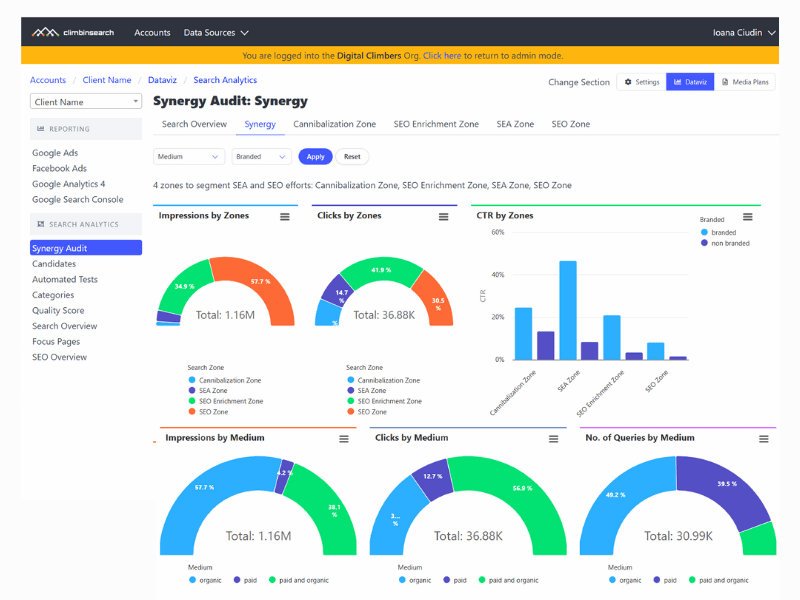
🪢 What is search analytics for SEO?
Search analytics for SEO means understanding how your queries perform across both organic and paid search. It helps you:
🪄 identify visibility gaps
🪄 understand opportunities for SEO improvement
🪄 detect cannibalization between paid and organic
🪄 measure performance with accurate monthly indicators
It gives SEOs a complete picture of their category, segment, and keyword performance.
🪢 How does using SEA data improve SEO strategy?
When SEO and SEA data come together, you immediately see where both channels overlap or underperform.
🪄 identify queries where paid spend is unnecessary
🪄 identify SEO queries worth prioritizing because SEA invests heavily
🪄 use SEA conversion data to guide SEO targeting
🪄 use SEO improvements to increase SEA Quality Score
A unified view helps both teams align and invest smarter.
🪢 What does custom data segmentation mean for SEO?
Custom segmentation lets you structure your search universe exactly the way your business needs it.
🪄 branded definitions
🪄 custom categorization rules
🪄 focus queries dashboards
This ensures your SEO work aligns perfectly with your business priorities and budgets.
🪢 What SEO KPIs are available in the performance dashboards?
Performance dashboards give you clarity at every level:
🪄 account
🪄 category
🪄 segment
🪄 focus query
You instantly see:
🪄 rankings
🪄 CTR
🪄 impressions
🪄 clicks
🪄 category insights
🪄 SEA overlap
This makes it easy to identify opportunities for growth and adjust your strategy.
🪢 How can search analytics accelerate SEO decision making?
With unified data and clear dashboards, you can make decisions faster:
🪄 identify which keywords to optimize
🪄 understand which categories need attention
🪄 detect where SEA should support or pause
🪄 prioritize actions based on potential impact
It removes guesswork from SEO
🪢 Why is category segmentation important for SEO?
SEO is not just keyword optimization. Category segmentation helps you:
🪄 see search demand by product or business line
🪄 align with media investments
🪄 identify category gaps
🪄 understand competitive visibility
This helps SEOs prioritize work where it has the biggest impact.
🪢 How does search analytics connect to business goals?
Search analytics helps you tie SEO strategy to measurable outcomes:
🪄 organic growth
🪄 lower paid spend
🪄 higher combined visibility
🪄 improved conversion rates
🪄 increased ROI
It makes SEO directly accountable to business KPIs.
🪢 Why is this approach essential for modern SEO teams?
Because SEO is no longer about isolated optimization. It is about aligning:
🪄 data
🪄 categories
🪄 funnel stages
🪄 paid and organic collaboration
🪄 testing
🪄 incremental growth
Search analytics gives SEOs the clarity, structure, and ongoing insights needed to grow continuously.
🪢 How does ClimbinSearch automatically reduce SEA SEO cannibalization?
Cannibalization happens when paid ads take traffic from strong organic rankings.
Automatic cannibalization tests in ClimbinSearch allow you to:
🪄 activate a test with one click
🪄 let the system pause and unpause search terms automatically
🪄 receive clear dashboards showing increased organic CTR and saved budget
Most clients see an uplift in organic metrics once tests are active, depending on their SEA and SEO maturity.
🪢 How does automatic cannibalization testing help SEO?
It identifies queries where organic rankings are strong enough to carry the load when paid is paused.
🪄 increased organic CTR
🪄 more organic clicks
🪄 freed SEA budget for strategic queries
🪄 increased combined ROI
This creates cleaner, more efficient SEO SEA collaboration.