SEO–SEA Experiments: How to Measure Incrementality Between Organic and Paid Search

Ioana Ciudin
January 30, 2026
An SEO–SEA experiment is a controlled, time-based test that measures how organic and paid search interact at query level, with the goal of proving incrementality rather than correlation. Unlike SEO-only or SEA-only tests, SEO–SEA experiments evaluate total search performance when paid visibility changes in the presence of organic rankings.

Why SEO–SEA experiments are necessary

Most search teams still evaluate SEO and paid search separately.
As a result, decisions are often based on:

  • short-term performance snapshots
  • attribution models that ignore substitution effects
  • assumptions about cannibalization

This creates false certainty.

In reality, organic and paid results compete and complement each other on the same SERP, for the same user intent.
SEO–SEA experiments exist to measure that interaction objectively, over time, at query level.

What SEO–SEA experiments are not

To avoid confusion, an SEO–SEA experiment is not:

  • an SEO A/B test
  • a Google Ads bid test
  • a short “pause ads and compare” exercise
  • a ranking impact test

SEO–SEA experiments do not attempt to prove that paid search replaces organic traffic, or vice versa.
They exist to measure incrementality and efficiency, not channel dominance.

Why SEO-only or SEA-only testing fails

SEO-only tests fail because:

  • they ignore paid pressure on the SERP
  • they cannot detect substitution effects
  • they overestimate organic growth

SEA-only tests fail because:

  • they ignore organic fallback behavior
  • they misinterpret demand as performance
  • they overvalue short-term efficiency

SEO–SEA experiments solve this by testing both channels together, under controlled conditions.

Introducing the Cannibalization Zone

Not all keywords are eligible for SEO–SEA experiments.

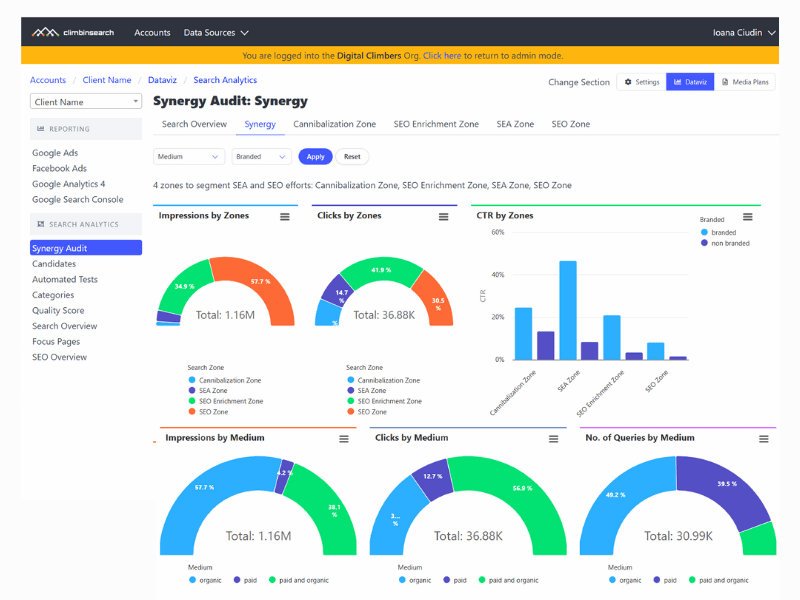
The Cannibalization Zone is the subset of queries where paid and organic visibility overlap enough to justify controlled testing.
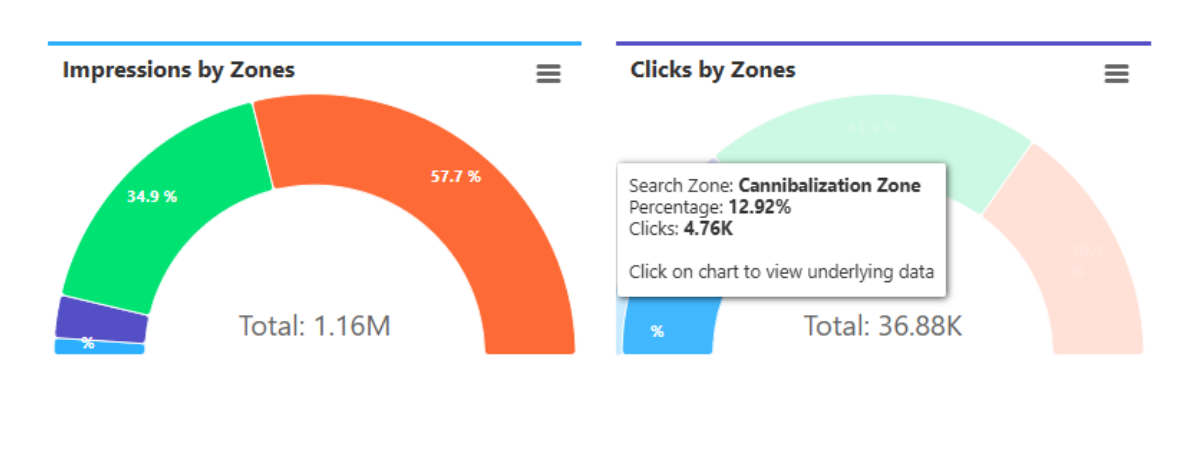
According to the automated methodology, the Cannibalization Zone typically includes keywords that meet all of the following conditions:

  • strong organic visibility (average organic position ≤ 2)
  • sufficient organic impressions
  • active paid visibility on the same queries
  • comparable impression levels between paid and organic

These are the queries where paid spend is most likely substituting organic demand, rather than expanding it.

Outside this zone, cannibalization tests are statistically unreliable or strategically irrelevant.

Which keywords are eligible for SEO–SEA cannibalization experiments

SEO–SEA experiments are always run at keyword level, not at campaign or page level.

Each month, a limited set of cannibalization candidates is generated automatically based on strict eligibility criteria:

  • Organic performance
    • average organic position < 2
    • organic impressions above a minimum threshold
  • Paid visibility
    • paid impressions above a minimum threshold
    • paid cost within predefined lower and upper limits
  • Impressions parity
    • paid vs organic impressions fall within a controlled ratio range

Only keywords that satisfy all conditions simultaneously enter the test pool.
This prevents biased experiments and protects overall performance.

Core types of SEO–SEA experiments

The most common SEO–SEA experiment types include:

1. Keyword cost-efficiency experiments

Paid search is used to identify high-cost queries. Organic performance is tested to determine whether paid spend adds net incremental value.

2. Ad copy to meta testing

Winning paid ad messages are tested as organic titles and descriptions to validate CTR impact.

3. Landing page validation via paid traffic

Paid traffic is used to test new pages or content formats before long-term SEO investment.

4. SERP cannibalization experiments

Paid visibility is systematically reduced to observe how organic performance responds over time.

A controlled methodology for SEO–SEA cannibalization experiments

Cannibalization cannot be measured with short pauses or static comparisons.

A valid SEO–SEA cannibalization experiment follows a standardized, repeatable lifecycle.

  1. Baseline period (Day 0–30)
    Paid ads active. Establishes benchmark for organic and paid performance.
  2. Learning period (Days 1–14)
    Ads are paused. User behavior begins to stabilize and early trends emerge.
  3. Extended test runway (Days 14–70)
    Daily monitoring determines whether the keyword moves toward success or failure.
  4. Reintroduction of paid keywords
    Paid visibility is restored after the test window.
  5. Fresh benchmark collection
    New baseline data is gathered to validate outcomes.
  6. Continuous eligibility re-evaluation
    Keywords can be reactivated automatically if performance degrades.

This structure ensures results reflect behavioral reality, not temporary effects.

What incrementality looks like in real data

A successful SEO–SEA cannibalization experiment shows:

  • organic CTR increases
  • additional organic clicks appear
  • paid cost decreases
  • total search performance remains stable

When these conditions are met, paid spend can be reduced or reallocated without harming growth.

Incrementality is proven when efficiency improves while total demand capture is preserved.

How success and failure are determined

SEO–SEA experiments require explicit success and failure rules.

A keyword is marked as successful when:

  • it remains present in Google Search Console
  • organic average position stays ≤ 2
  • organic CTR reaches or exceeds expected thresholds

A keyword fails when:

  • organic visibility disappears
  • organic position deteriorates beyond limits
  • organic CTR collapses relative to expectations

Failed keywords are automatically reactivated in paid search to protect performance.

The role of dashboards in SEO–SEA experiments

SEO–SEA experiments only work when results are visible and comparable.

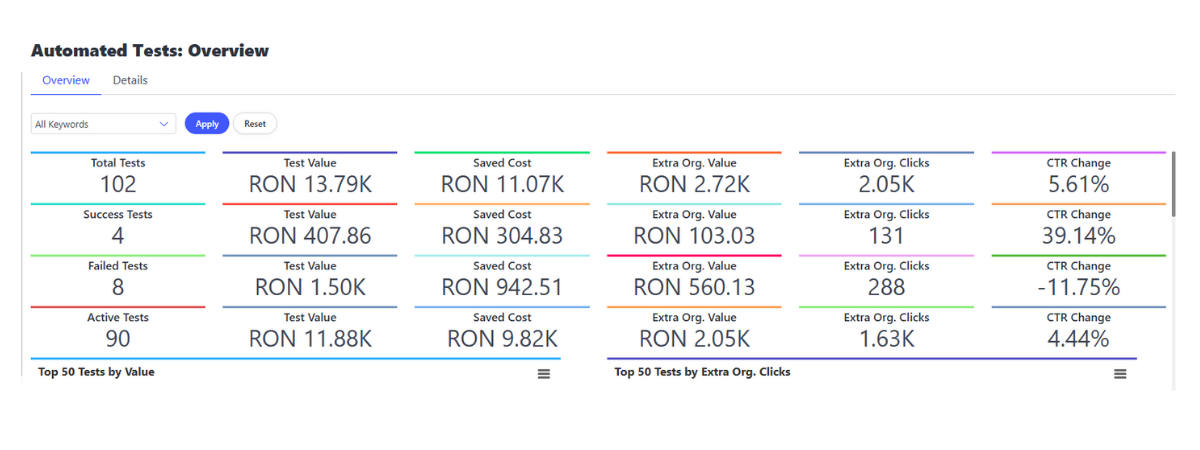
Dedicated dashboards provide:

  • Cannibalization Zone size and distribution
  • Active test candidates (limited to a controlled number)
  • Keyword-level performance during baseline, learning, and test phases
  • Clear success vs failure status
  • Estimated cost savings vs organic value gained

These dashboards allow teams to evaluate experiments daily, not retrospectively.
What SEO–SEA experiments explicitly do not assume

Proper SEO–SEA experiments:

  • do not assume paid search improves rankings
  • do not assume organic fully replaces paid traffic
  • do not rely on attribution models alone
  • do not draw conclusions from short test windows

They are designed to remove assumptions, not reinforce them.

From experiments to a system

SEO–SEA experiments only create value when they are:

  • repeatable
  • keyword-level
  • long-run
  • continuously monitored

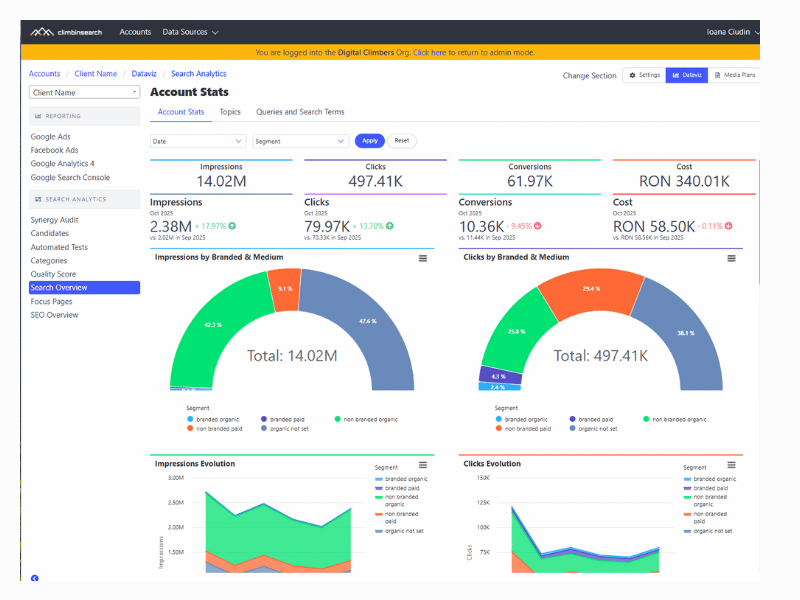
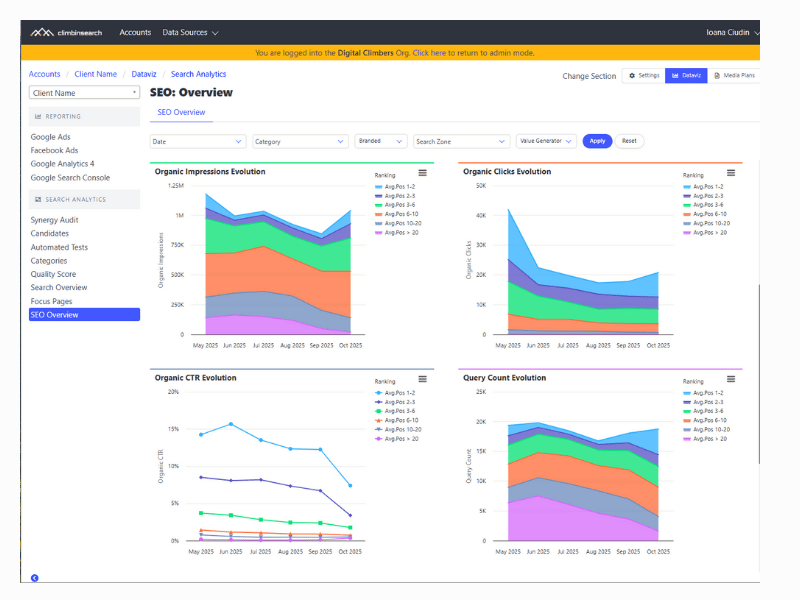
In practice, this requires combining Google Ads and Google Search Console data and evaluating results over time.

ClimbinSearch operationalizes this approach by running automated SEO–SEA cannibalization experiments on top of search analytics, enabling performance and SEO teams to make defensible budget and strategy decisions based on observed incrementality, not intuition.

Why SEO–SEA experiments matter now

As search results become more crowded and budgets more constrained, intuition is no longer sufficient.

SEO–SEA experiments provide a way to:

  • validate assumptions
  • protect growth
  • improve efficiency
  • align SEO and performance teams around the same data

SEO–SEA experiments are not a tactic.
They are the only reliable method for measuring incrementality in search.

SEO and SEA teams do not need to coordinate manually

Traditional SEO–SEA alignment assumes frequent meetings, shared documents, and manual handoffs between teams.

In practice, this rarely works.

SEO and SEA teams operate on different cadences, tools, and success metrics. Coordination becomes dependent on availability, interpretation, and subjective judgment. As a result, decisions are delayed, diluted, or never implemented consistently.

SEO–SEA experiments remove the need for manual coordination.

Unifying silos through a shared system, not meetings

In an experimentation-based model, SEO and SEA teams do not need to talk to each other continuously.
They need a shared system.

When both channels feed data into the same experimentation framework:

  • hypotheses are defined once
  • tests run automatically
  • results are evaluated objectively
  • decisions are documented in data, not conversations

The system becomes the single source of truth.

SEO and SEA no longer exchange opinions.
They exchange observed outcomes.

How this changes collaboration

In a unified SEO–SEA experimentation system:

  • SEO teams see how organic performance behaves when paid visibility changes
  • SEA teams see where paid spend is incremental and where it is substitutive
  • budget decisions are triggered by test results, not negotiation
  • strategy evolves continuously, without coordination overhead

This does not remove collaboration.
It removes friction.

ClimbinSearch as a system of record for SEO–SEA decisions

ClimbinSearch acts as the unifying layer between SEO and SEA by:

  • combining Google Ads and Google Search Console data
  • defining eligibility rules for experiments
  • running tests automatically at keyword level
  • exposing results through shared dashboards
  • enforcing consistent success and failure criteria

SEO and SEA teams interact with the same dashboards, the same experiments, and the same conclusions, even if they never meet.

Alignment is no longer a process.
It is a property of the system.

Why this matters at scale

As organizations grow, manual coordination does not scale.
Systems do.

SEO–SEA experiments embedded in a shared platform allow teams to:

  • operate independently
  • stay aligned implicitly
  • make defensible decisions
  • avoid silo-driven bias

This is how SEO and SEA stop being parallel functions and become inputs into the same decision engine.
Bring Clarity to Your Search and Digital Media Workflows

Plan faster. Report smarter. Understand your performance in one place.
Book a Demo