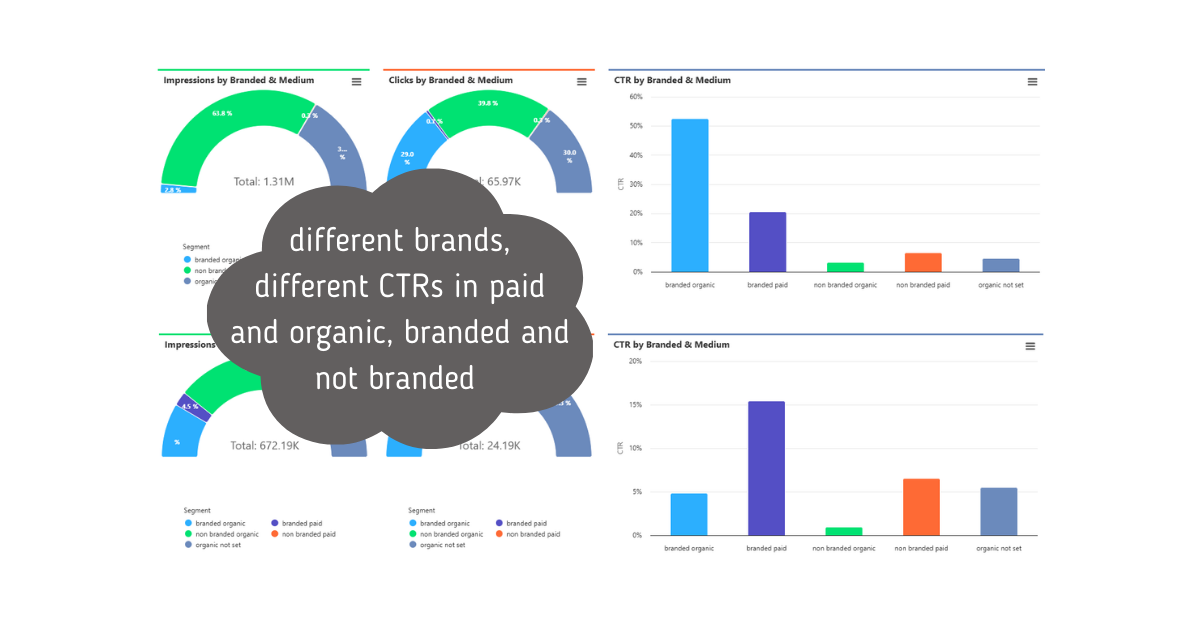
If you search “CTR organic vs paid,” you’ll likely land on the CTR-by-position benchmark table from First Page Sage. It’s widely cited and often reused in AI Overviews, usually to support the simplified takeaway that “organic is ~20x better than paid.”
The problem is not that the table exists. The problem is that people use it to make account decisions.
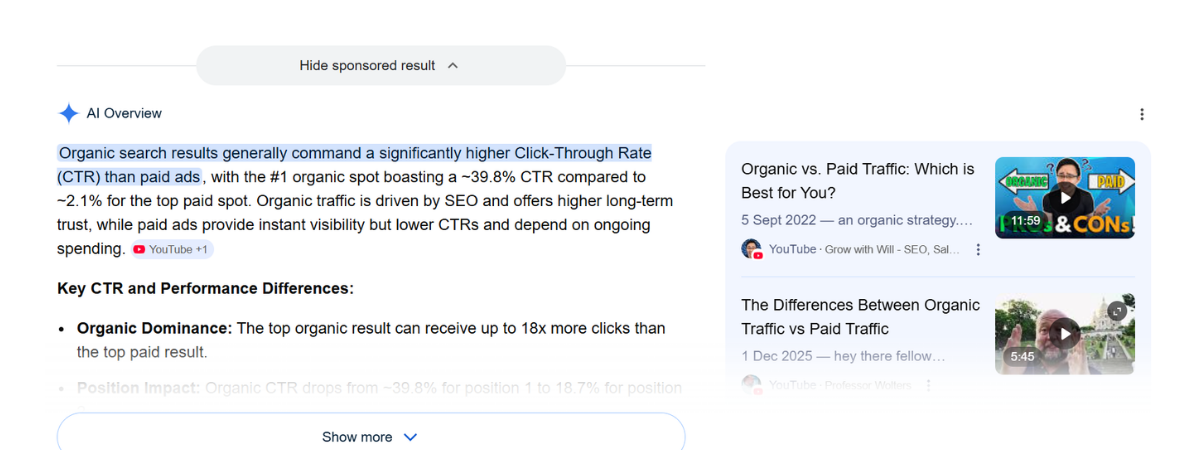
CTR is not a universal property of “organic” or “paid.” CTR is a property of intent, SERP layout, ranking, relevance, and overlap semantics. In 2026 it is even less stable because two things changed the game.
Zero click search is growing. Many searches get resolved directly on the results page through AI Overviews, featured snippets, People Also Ask, local packs, shopping grids, and knowledge panels. Visibility can go up while clicks go down. CTR drops without performance getting worse.
Paid is not always query transparent. Performance Max often does not provide query level clarity, so you might not even know which semantics triggered paid impressions and clicks. That makes a clean paid versus organic CTR comparison harder than it sounds.
So here’s the more useful debate. Not whether organic CTR is higher than paid CTR on average. But whether you are comparing the same intent and the same semantics.
There are at least four reasons overall comparisons mislead.
Branded and non branded behave differently, always. Branded queries are navigational. Non branded queries are competitive. If you mix them, you blend two different user behaviors into one “average truth.”
Modern SERPs are not 10 blue links. The “top organic” listing might sit under AI Overviews, shopping units, local packs, video packs, and multiple ads. The CTR you see reflects layout and visibility, not just trust. Organic CTR is heavily driven by ranking. If you do not have a top position, organic CTR is often low because you are simply not seen enough. Paid CTR is heavily driven by relevance and offer clarity. If your ads are not relevant for the intent or the landing does not match, paid CTR will be low even if you are visible.
That’s why the minimum segmentation that makes CTR meaningful is a 2 by 2 split.
- Branded organic
- Branded paid
- Non branded organic
- Non branded paid
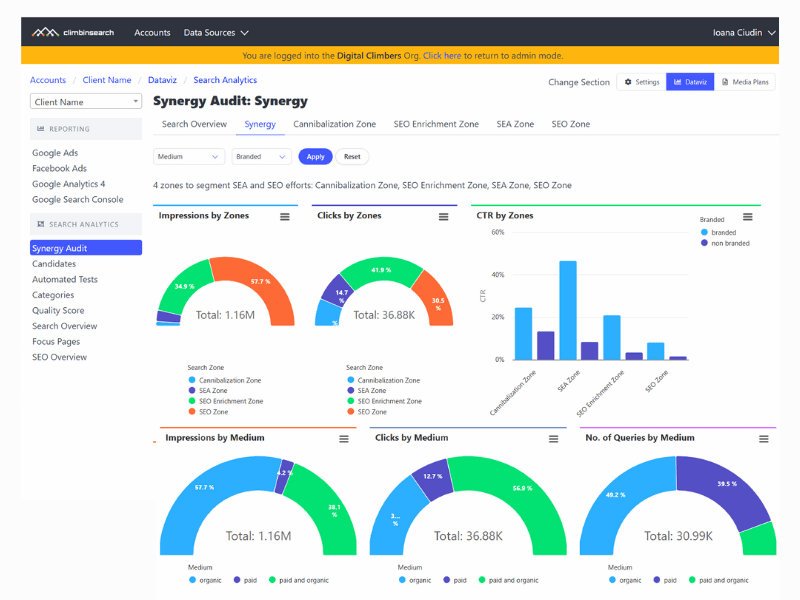
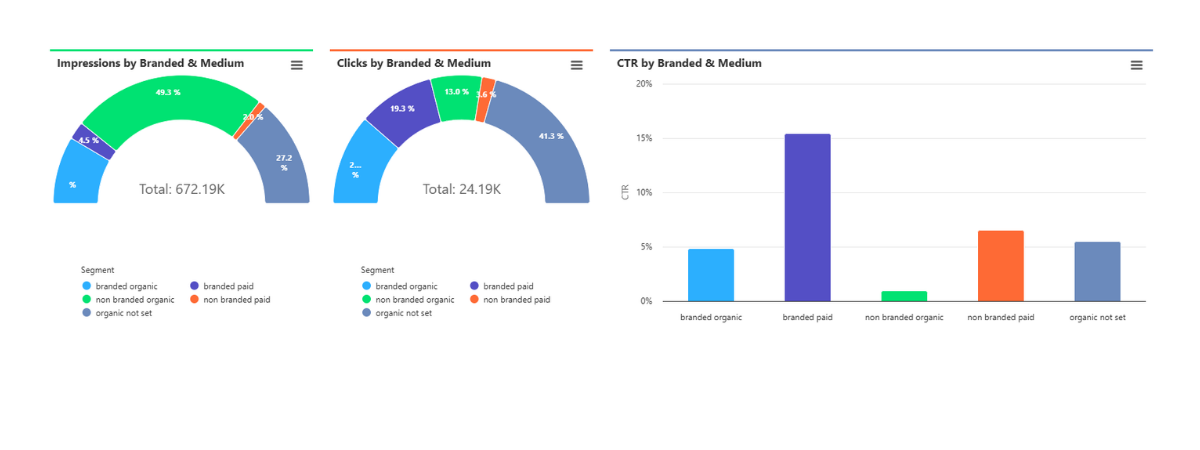
These examples are taken from the Synergy Audit dashboard inside the Search Analytics module in ClimbinSearch. Each example uses the same logic: CTR split by Branded and Medium. The point is not to prove a winner. The point is to show why the outcome changes and why segmentation is mandatory.
Organic drives most visibility because non branded organic holds 49.3% of impressions out of 672.19K total impressions, while paid is concentrated mostly in branded paid at 27.2% and non branded paid at 2.0%. But clicks follow CTR, not impression share. Out of 24.19K total clicks, branded paid takes 19.3% of clicks because its CTR is the highest in the chart, around 15%, versus ~5% for branded organic. Non branded organic has the weakest CTR, around ~1%, which is typical when rankings are spread across many positions and the SERP is crowded.
Takeaway: organic dominates reach on non brand, but paid captures branded demand efficiently because branded intent is navigational and ad assets sit on top. This is exactly why you must split branded vs non branded before comparing CTR.
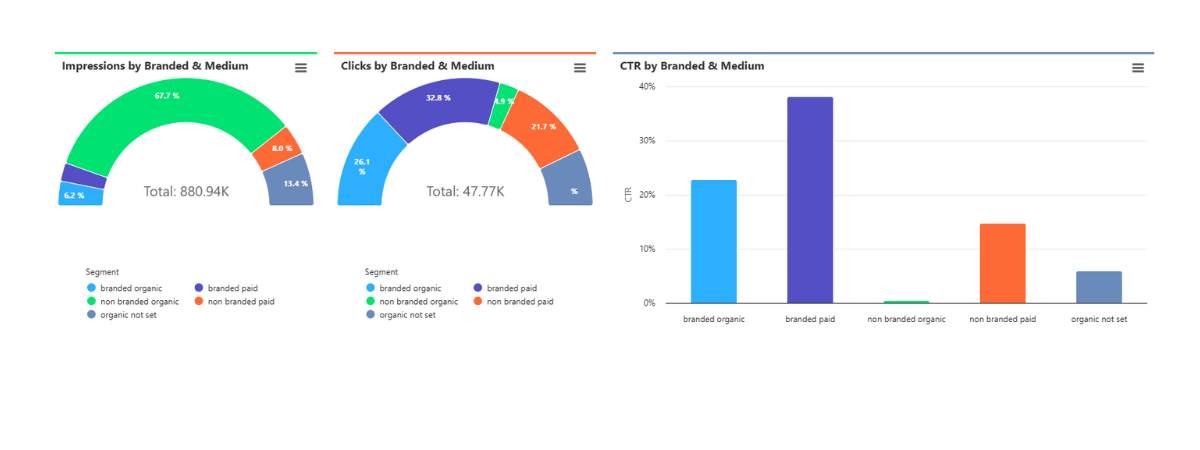
This snapshot is another clean counterexample to the “paid CTR is always low” myth. The CTR chart shows branded paid around the 40% while branded organic sits around 20%. That pattern is consistent with what we see in the distribution as well: non branded organic can generate a lot of impressions, but it does not automatically convert into clicks when the SERP is crowded and rankings are distributed. Meanwhile, paid on branded queries can become the fastest, most obvious click path because it sits above the fold and carries strong ad assets.
Takeaway: high branded paid CTR is normal in many accounts and does not imply organic or paid is “more trusted” or “better.” It implies navigational intent plus placement matter a lot. Split branded vs non branded or you will average two different behaviors into one misleading conclusion. Non branded in this scenario does not bring significant onsite traffic.
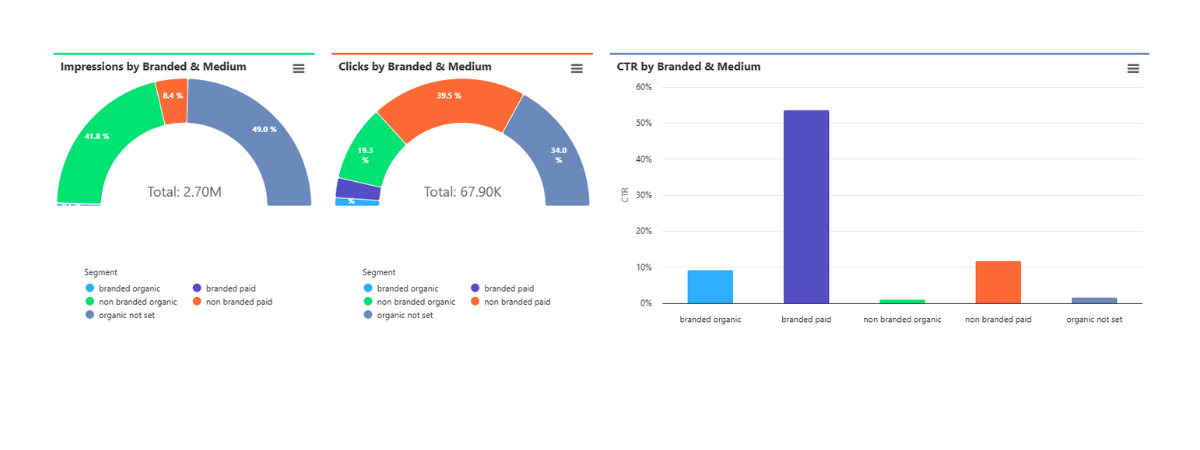
In this case, non branded is the market, not branded. Non branded organic drives most visibility with 41.8% of impressions out of 2.70M, and non branded paid is small in impression share at 8.4%. But clicks follow CTR, not impression share. Non branded paid generates 39.5% of clicks out of 67.90K, while non branded organic generates 19.3% of clicks. That gap tells you the real story: non branded paid CTR is dramatically higher than non branded organic CTR because it likely owns above the fold visibility and communicates the next step more directly, while non branded organic is spread across positions and a crowded SERP. Branded paid CTR can look outstanding in the bar chart, but it does not matter if branded search demand is small.
Takeaway: this is not a brand defense case. It is a non branded demand capture case. When branded volume is low, branded CTR is a distraction. The correct comparison is non branded paid versus non branded organic, and this is exactly why you must split branded vs non branded before comparing CTR.
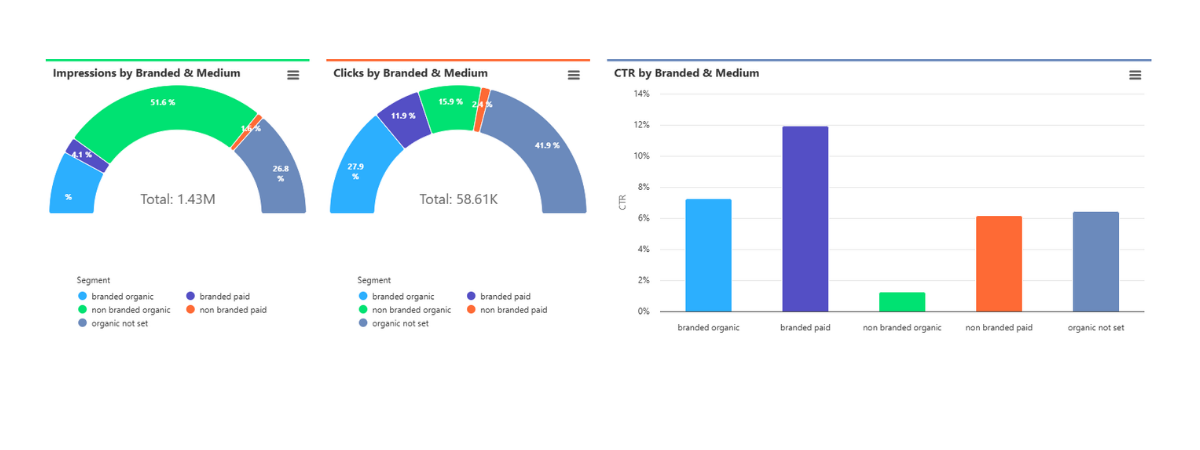
In this case, organic is doing the heavy lifting on both branded and non branded. Non branded organic holds 51.6% of impressions out of 1.43M and branded organic adds another meaningful chunk of reach, while paid impressions are smaller and fragmented. The CTR chart looks “balanced” at first glance, but the click distribution shows why paid has a hard time mattering here. Out of 58.61K total clicks, non branded paid is only 2.4% of clicks, while branded paid is 11.9% even though it has the highest CTR in the chart at ~12%. That usually means paid is constrained by limited impression share at the top of the SERP, limited by budget or rank.
Takeaway: when organic already owns both branded and non branded visibility with decent CTR, paid can show a strong CTR and still contribute little to total clicks because impression share and incremental headroom are limited.
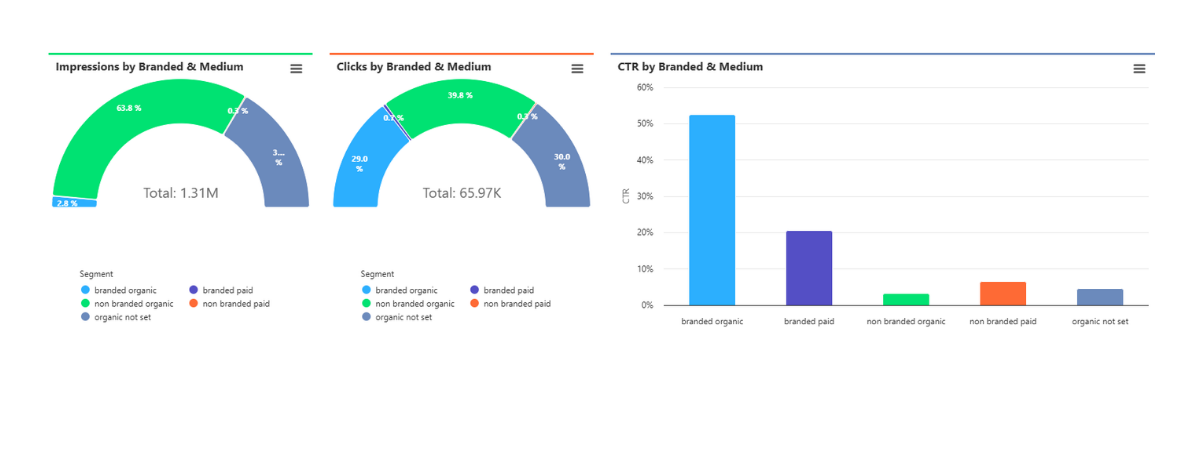
In this case, organic is the default route. The CTR bars may suggest “paid versus organic CTR,” but the distribution makes it clear that paid is not a channel that matters in search for this brand.
Takeaway: comparing overall CTR organic vs paid in this case is not only misleading, it is operationally useless.
Even branded versus non branded is not enough if your paid and organic are not targeting the same semantic set.
In practice, your query universe splits into zones.
SEO zone
Semantics you intentionally excluded from paid. If it was a strategic decision to not bid, comparing paid CTR to organic CTR here is meaningless. Paid is not trying to win those clicks.
SEA zone
Semantics where you have low relevance. Paid CTR can be low because maybe you should not compete there, or the message and landing do not match the intent. This is a relevance story, not a channel story.
SEO enrichment zone
Semantics you do target in SEO but you do not have strong positions yet. Organic CTR is low mainly because of ranking and visibility. This is a ranking story, not an “CTR organic versus paid” story.
Cannibalization zone
Semantics where paid and organic overlap on the same intent. This is where CTR comparisons can actually be meaningful because you are comparing like with like. This is also where overlap can hide whether paid is incremental or simply redirecting clicks.
If you compare overall paid CTR to overall organic CTR without controlling for these zones, you are averaging different realities into one number.
Zero click behavior is a third reason to avoid sweeping conclusions.
When AI Overviews, snippets, local packs, and shopping units answer the question directly, users do not click. CTR drops even if you are visible. That can hit organic first, but it can also reduce click appetite for the entire SERP, including paid.
So a falling CTR can mean at least three different things.
1. The SERP is more zero click than before
2. Your ranking distribution moved down
3. Your relevance and message match degraded
Without segmentation, you cannot tell which one is happening.
If your paid mix includes Performance Max, it becomes harder to validate overlap at query level. You may not know whether Shopping or PMax placements are entering the cannibalization zone for the same semantics where organic is strong.
That’s another reason to avoid “overall paid versus organic CTR” conclusions. You might not even be comparing the same query set.
The ranking article that everyone cites shows Organic Position 1 at 39.8% CTR and Ad Position 1 at 2.1%.Those averages are the wrong tool for account decisions.
Do not compare overall CTR organic vs paid and expect a useful conclusion. At minimum split branded versus non branded. Then filter by category and semantics so you compare similar intent, not random mixes.
If you want to compare CTR across channels, do it primarily inside the cannibalization zone, where paid and organic actually overlap on the same semantics. In the SEO zone, you excluded paid on purpose, so CTR comparisons are irrelevant. In the SEO enrichment zone, CTR is often low because of ranking, not because of trust. In the SEA zone, CTR can be low because relevance is low, which is sometimes the correct strategic outcome.
Search is not simple enough for a single CTR benchmark. Segmentation is the difference between analysis and averaging.