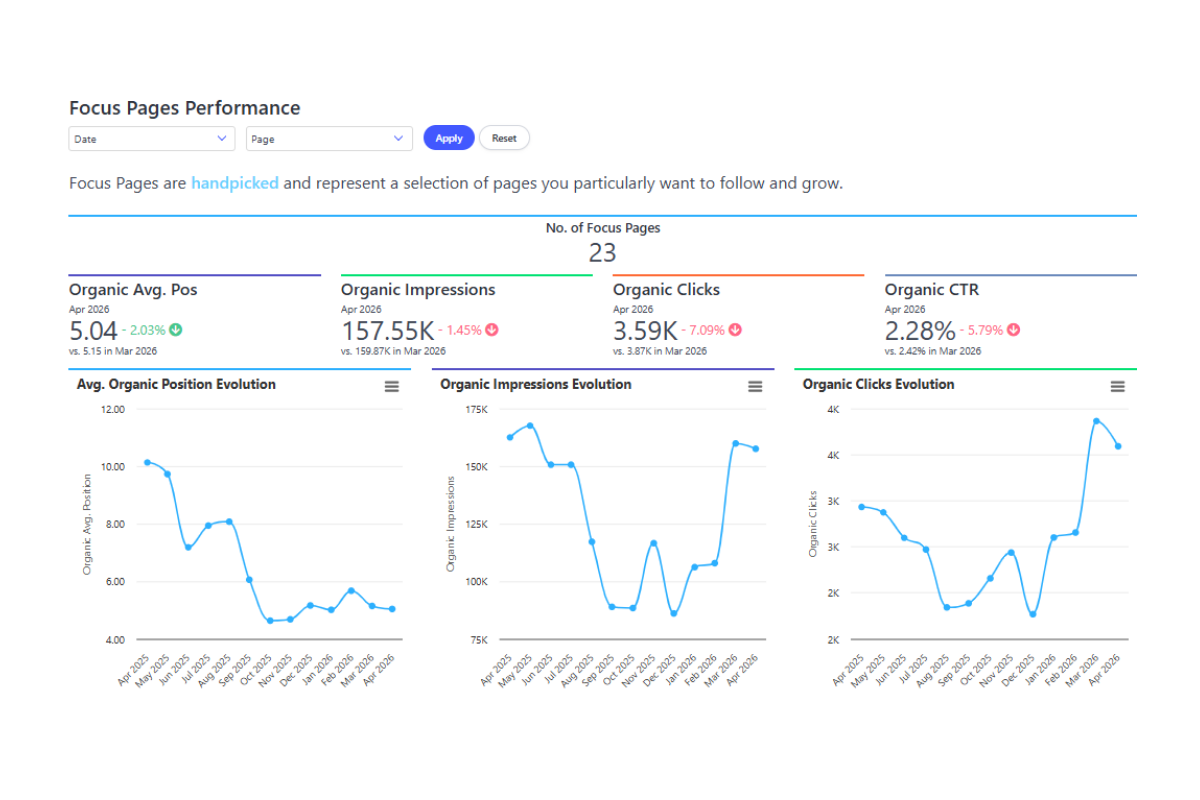
SEO cannibalization usually becomes visible before teams agree on what it means. In dashboards, it shows up as one query producing traffic for multiple URLs, rankings moving between pages without a stable winner, and impressions rising while clicks stay flat. That pattern matters because it changes how growth behaves. Instead of one page accumulating authority over time, signals get split across competing URLs, and the category becomes harder to scale.
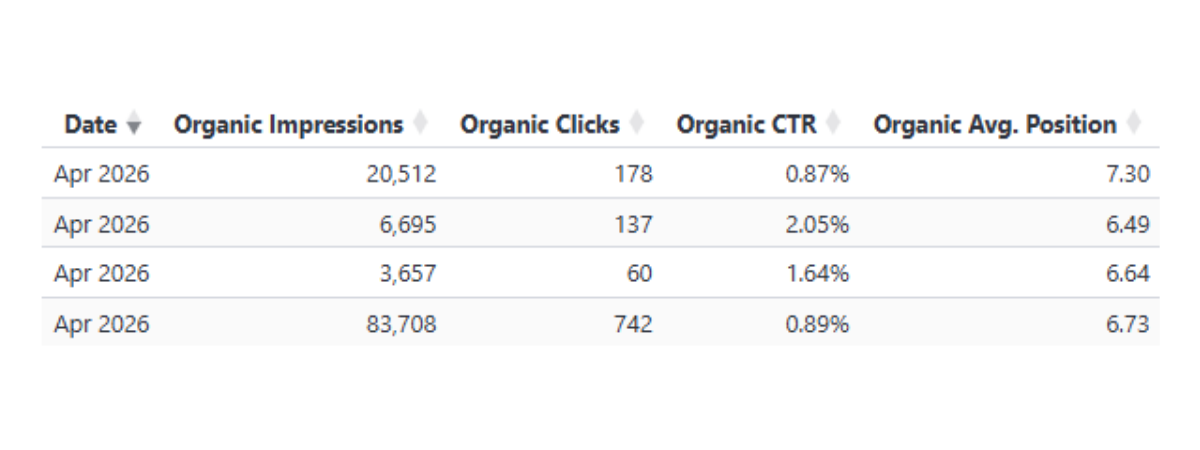
In operational terms, SEO cannibalization is a situation where multiple pages from the same domain compete for the same or very similar search intent. The result is not simply “duplicate content.” More often, it is a visibility problem: Google distributes impressions, positions, and clicks across more than one URL, and no page becomes the clear owner of the query set.
The theoretical definition is easy to repeat. The practical impact is more useful: rankings become unstable, CTR is diluted, and the page that should consolidate authority may never receive enough consistent signal to hold a top position. That is why cannibalization often appears as volatility, not as an obvious penalty or drop.
Teams usually notice it when a query shows two or more landing pages in search analytics over the same period, or when a page that used to rank well starts losing impressions to a related article, category page, or product page. The issue is not always that one URL is “bad.” The issue is that the search engine is not being given a strong enough ownership signal.
Search data rarely announces cannibalization directly. It reveals it through patterns. The first signal is often impressions behavior. If a query or topic cluster is growing in impressions but clicks are not rising proportionally, the team should inspect which URLs are receiving visibility. A category may be expanding, but if several pages are capturing fragments of the same demand, the click distribution stays weak.
Another common pattern is ranking distribution. One URL may hold positions 6 to 12 for weeks, then another URL appears in positions 8 to 15 for the same query set, and neither progresses into durable top-five visibility. This is especially visible when a query maps to different pages across time. The ranking pattern is not random; it often reflects Google testing which URL best satisfies intent.
Query overlap is the second important signal. When multiple pages receive impressions from very similar terms, especially within the same category, the likelihood of cannibalization rises. The overlap is most meaningful when the pages are not differentiated by intent. For example, a guide, a comparison page, and a category page may all begin appearing for the same commercial query set, even if only one should own the primary demand.
Multiple pages competing for the same query set can also be seen in SERP examples. One week the blog post ranks; the next week the product page appears; then the category page returns. This movement often looks like instability, but from Google’s perspective it may be a short-term evaluation cycle rather than a fixed ranking decision.
Google does not always choose one URL immediately. It often tests several pages to understand which one matches the search intent most reliably. That is especially common when the site has multiple pages covering the same subject from different angles. A commercial intent query may trigger a product page, a category page, and a guide because each page offers partial relevance.
This testing behavior explains why rankings fluctuate across pages. If the algorithm is unsure which URL deserves the query, it may rotate results based on freshness, internal linking, backlinks, engagement signals, or content proximity. The result is visible in dashboards as impression spread, not as a clean single-page win.
Visibility can also disappear after initial testing. A page may briefly gain impressions because it matches a query cluster well enough to be evaluated, then lose them when Google finds stronger evidence elsewhere on the site or outside it. This is one reason teams misread temporary visibility as a stable opportunity. In reality, the page may have passed an initial test but failed to consolidate ownership.
SEO growth compounds when authority accumulates around the right page structure. Cannibalization interrupts that compounding effect. Instead of one URL building stronger rankings, the site spreads internal links, relevance signals, and external authority across several pages. Each page ends up weaker than it should be.
This matters most at category level, where long-term visibility is usually built. A mature category should show a controlled relationship between the primary commercial page, supporting articles, and related subcategory pages. When too many pages target the same query family, the category becomes fragmented and growth becomes harder to sustain.
The impact is often more visible in impressions than in clicks. Impressions may look healthy because the domain is appearing in the SERP through several URLs, but clicks do not scale at the same rate because the positions are split and the strongest page does not own enough of the demand.
Cannibalization is not always a negative signal. In some cases, it indicates topic expansion. A domain may begin with one core page, then add supporting pages that capture adjacent long-tail demand. If those pages are clearly differentiated by intent, the overlap can be useful. The site starts occupying more of the category without creating internal confusion.
It can also be a temporary testing phase. Early-stage content often enters search with multiple URLs visible because Google is still learning how the site organizes the topic. If the site has weak historical authority in that area, the algorithm may test several pages before settling on a winner. In that phase, the right move is not always consolidation; it may be clearer intent, stronger internal linking, and better query assignment.
Sometimes cannibalization simply indicates a lack of page ownership. That is different from a structural problem. The site may have no single page clearly mapped to the main query family, so several pages absorb partial demand. In that case, the issue is not overproduction of content alone. It is the absence of an editorial and technical hierarchy.
Teams that work well with cannibalization do not start with page counts. They start with query clusters and landing page behavior. The first step is to identify focus queries for a topic cluster. These are the queries that should have a primary owner page. Once those queries are defined, the team can inspect which URLs are receiving impressions and clicks for the same set.
Query overlap is usually the most practical diagnostic. If two or more pages repeatedly rank for the same search terms, and those terms belong to the same intent set, the site is likely diluting ownership. The next layer is ranking distribution. If the same query toggles between several pages over time, the page architecture is not giving Google a consistent signal.
Visibility versus click distribution is also important. A query cluster may generate broad impressions across several pages, but clicks often concentrate in one or two positions. If the top page changes frequently, the click distribution becomes unstable. That instability can hide the real scale of the issue because total traffic may still look acceptable while growth stalls.
The Focus Queries view helps surface this behavior operationally:
• visibility trends
• impression distribution
• click concentration
• CTR evolution
• ranking consistency over time
If the same query repeatedly shifts between several URLs, the site is often sending mixed signals to Google about which page should rank for that intent.
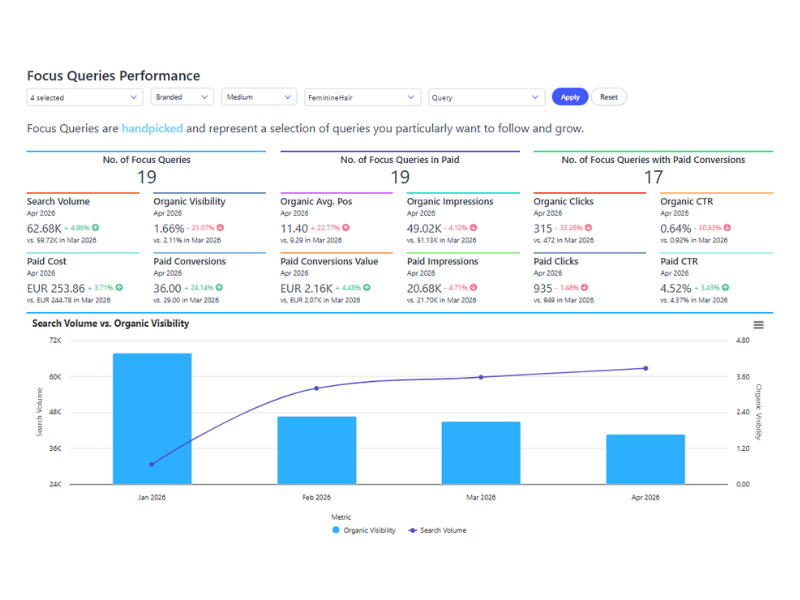
Modern teams also look at category-level analysis. They do not inspect pages one by one in isolation. They review how the entire category behaves: which URL is the focus page, which URLs are supporting content, which queries are being shared, and where overlap is helping or hurting. This is where cannibalization becomes a workflow issue instead of a one-off content problem.
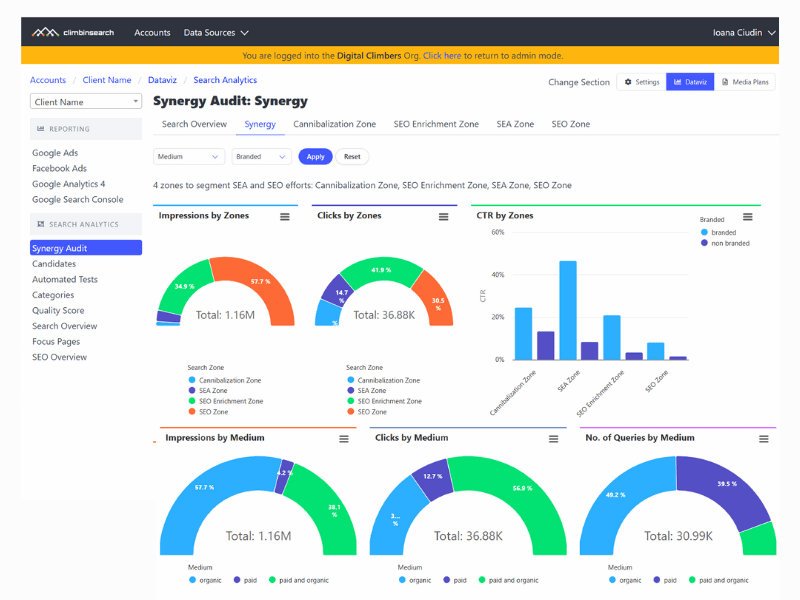
Cannibalization can also appear between SEO and paid search. In some cases, the paid team is bidding on the same high-intent queries that the organic team is trying to own, and the two channels interact in ways that are not immediately obvious. The problem is not always direct competition. Sometimes paid search is filling a gap that organic has not yet consolidated. In other cases, paid spend is supporting branded or category queries that organic already owns at a strong position.
Operationally, the important question is whether paid spend is enriching organic performance or masking a structural issue. If SEO is weak on a core commercial cluster, paid can provide coverage while the site consolidates authority. If SEO already owns the query set well, paid may be cannibalizing clicks that would have been captured organically, especially on branded or near-branded terms.
This is why teams should compare impression share, click share, and query-level overlap across channels. A query may look efficient in paid search while organic loses momentum because the same landing page strategy is split across both channels. The best decisions usually come from treating SEO and paid search as one demand system rather than separate reporting lines.
The first fix is page consolidation, but consolidation is not simply deleting content. It means identifying the correct primary URL for the topic, then merging or redirecting weaker pages where appropriate. The goal is to concentrate relevance, internal links, and external signals around one clear owner page.
Focus queries and focus pages should be assigned explicitly. Each important topic cluster needs a page whose job is to own the primary commercial or informational intent. Supporting pages should be mapped to secondary intents, long-tail variations, or adjacent questions. When this mapping is missing, overlap tends to reappear even after a cleanup.
Internal linking should reinforce the chosen hierarchy. Links from supporting pages should point toward the focus page with consistent anchor context. Category navigation, breadcrumbs, and related content modules should all reflect the same ownership logic. If the site’s link structure still treats multiple pages equally, Google receives mixed signals.
Content alignment matters as well. A page should be built around one dominant intent, not multiple half-aligned objectives. If a guide is trying to rank for a transactional query while a category page is also targeting the same term, one of them usually needs to be repositioned. Reducing overlap often improves performance faster than creating more content.
Authority signals should also be strengthened around the selected page. That can mean earning links to the focus page, improving internal prominence, updating content depth, or increasing topical coverage without drifting into duplicate intent. The point is to make ownership easier for the search engine to interpret.
Not every overlap should be removed. Some overlap reveals where the site has room to expand into adjacent intents. A cluster of pages ranking for similar terms may indicate a category that is still forming. In that situation, the correct response may be better segmentation rather than consolidation.
That is where query clustering becomes useful. Teams can group terms by intent, then determine whether the site should own them with one page or several. The decision should be based on SERP behavior, not editorial preference. If the SERP rewards one page type for a cluster, the site should reflect that structure. If the SERP supports multiple intents within the same theme, then overlap may be part of a healthy growth pattern.
Modern analysis is less about eliminating every sign of competition and more about identifying where competition is helping or hurting. A temporary test between pages can lead to better page selection. A broad category may benefit from supporting pages that capture long-tail demand. But when the same query family keeps rotating across multiple URLs without a stable winner, the site usually needs clearer ownership.
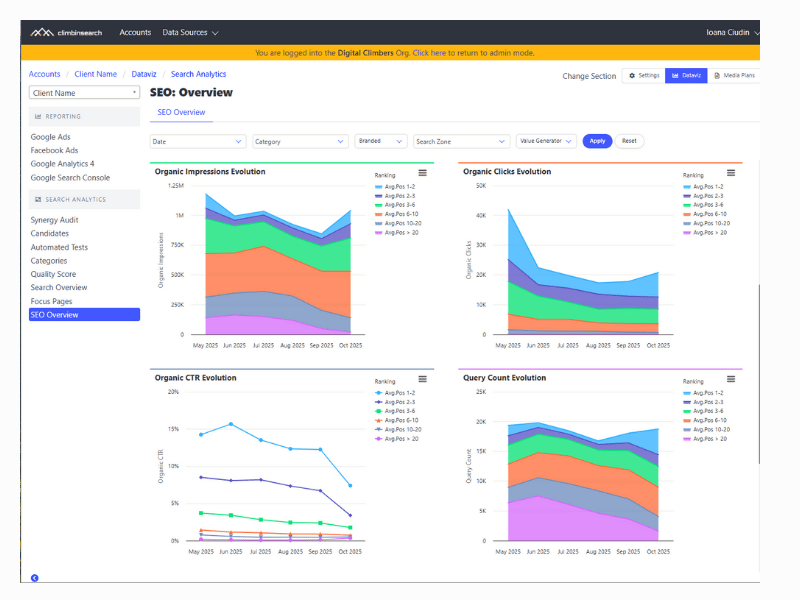
The clearest operational view comes from tracking visibility evolution over time, not single-date rankings. Look at impressions first, then clicks, then page-level distribution. If impressions rise while one page fails to separate from the rest of the cluster, the site is accumulating demand without consolidating it.
Pay attention to the relationship between new content and changing visibility. When a new page enters the cluster, observe whether it expands the category or absorbs demand from an existing page. That distinction determines whether the change is enrichment or cannibalization. The same pattern can look positive in a content calendar and negative in search analytics.
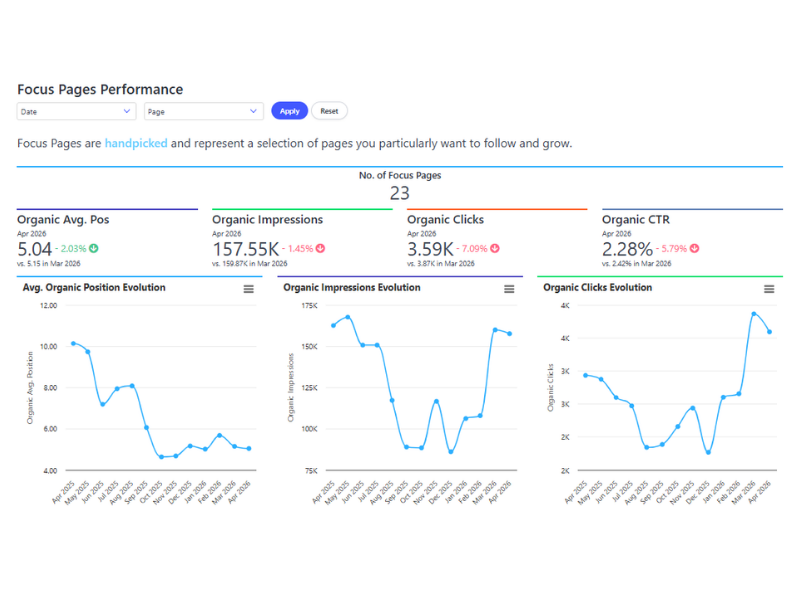
Also review how often queries switch landing pages. Frequent switching suggests weak ownership. Stable ownership with rising impressions suggests the opposite. The best-performing categories usually show a clear focus page, a defined set of supporting pages, and a controlled boundary between them.
SEO cannibalization is best understood as a failure of page ownership under real search conditions. It shows up in impressions, query overlap, ranking distribution, and page rotation more than in definitions. The issue is not always harmful, and in some cases it signals healthy topic expansion or an active Google test. But when the same query family cannot settle on a primary URL, growth becomes fragmented and harder to compound.
The practical response is not generic cleanup. It is operational discipline: define focus queries, assign focus pages, reduce overlap, strengthen internal linking, and align content with the search intent the SERP is actually rewarding. Teams that analyze cannibalization this way tend to move faster because they are not reacting to isolated ranking changes. They are managing category-level visibility as a system.